A few reasons – and how you can avoid it. (Just kidding, you’re probably screwed!)
The more data and qualitative research I undertake as I blow through my unemployment/severance, the more I learn that many people are absolutely burnt the *F* out at their jobs. It was certainly how I felt at the tail end of my employment, but I was fortunate to leave with enough runway to try and pursue a different path.
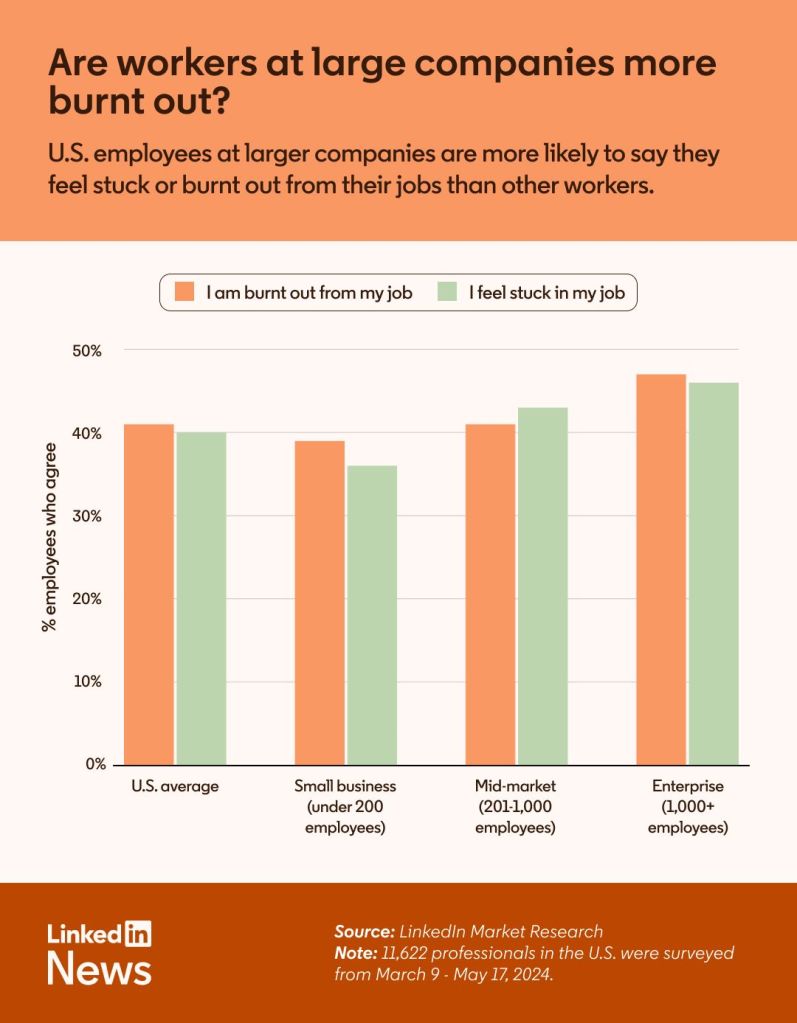
Why are people burnt out? After all, it seems that job flexibility with hybrid/WFH is as good as it’s ever been (outside of the pandemic when, in SF, we literally had to wear masks outside) which results in more free time, increased take-home $ due to lower commuting expenses and fewer $20 salads, and the ability to rent/purchase housing in lower cost of living areas.
A few of the reasons for the burnout likely include:
- Increased disengagement
- Blurred division of responsibilities
- Increased expectations from employees
- Poor leadership decisions resulting in all of the above + layoffs
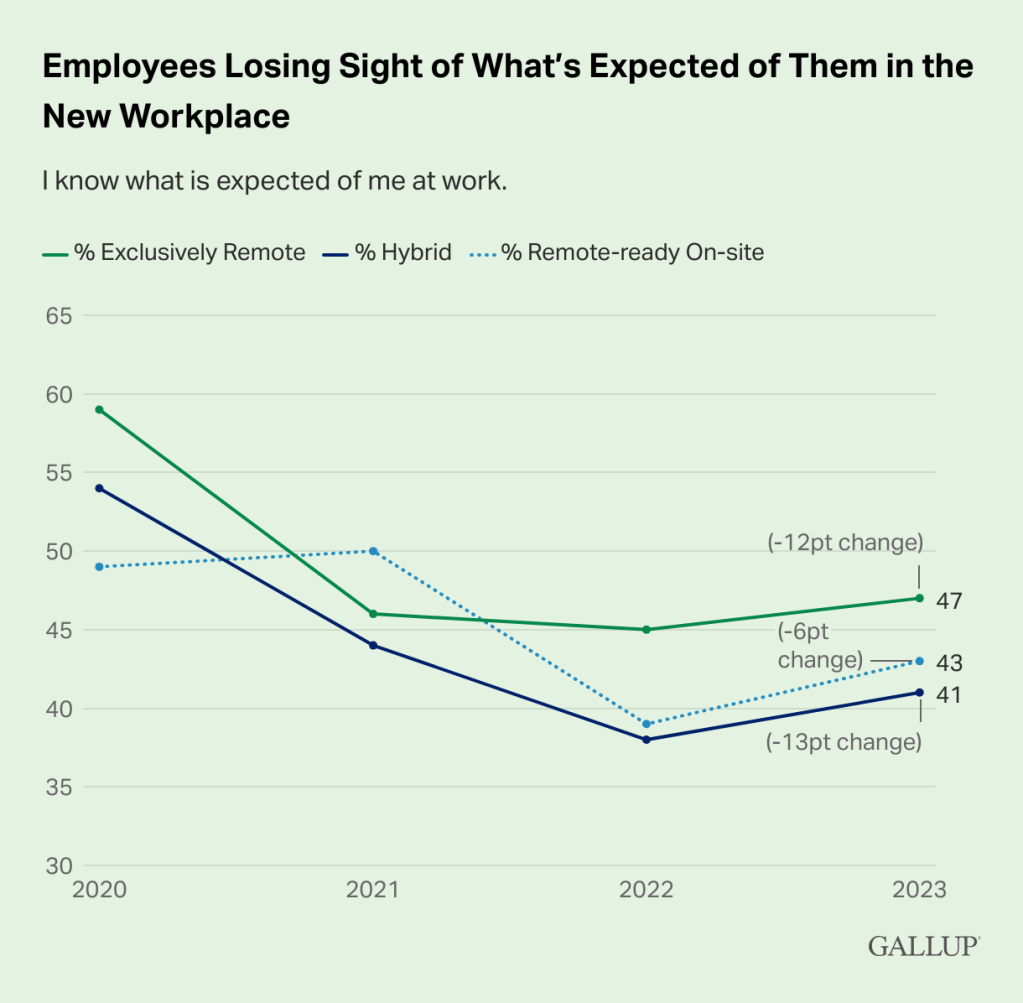
Increased company disengagement across the board (with remote work as the catalyst)
Remote work is loved for its convenience, which is a drug we cannot resist the lifelong pursuit of. However, in my opinion, this drug does not lend well to companies growing/maintaining their innovation. I’ve been observing the following behaviors which I believe remote work has catalyzed from these three groups :
- Leaders (mostly Boomers) are focusing more on participating in even more meetings, managing up, and throwing people under the bus for the specific benefit of elevating themselves. This results in the opportunity cost of not setting the proper vision/tone for their departments which flows down to the…
- Middle-managers (mostly Gen X and Millennials) who are getting fewer opportunities to connect with workers above, at, and below their levels. These folks have the ability to delegate much of their work, and they realize they are being trained to improve their skillset on stupid corporate things (like sucking up, “building consensus,” backstabbing) vs actually creating things and building value. Likely a huge reason Elon and Zuck are ridding themselves of this layer (which I’m sure other companies will adopt).
- The lower-level folks (Gen Z) who are either overwhelmed or not busy enough with meaningful work while simultaneously disempowered with lack of the learning and engagement opportunities available to older generations (via in-office socialization and travel opportunities).
Blurred division of responsibilities
During the periods of ZIRP (Zero Interest Rate Policy) between 2008 and 2015 and 2020-2022, job openings ticked up greatly (as seen in the BLS data below). ZIRP incentivized companies to hire more folks as a result of lower borrowing/opportunity costs. These job openings especially boomed in 2020-2022 during COVID as company revenue grew through increased spending from stimulus checks and increased personal savings which resulted in job growth.
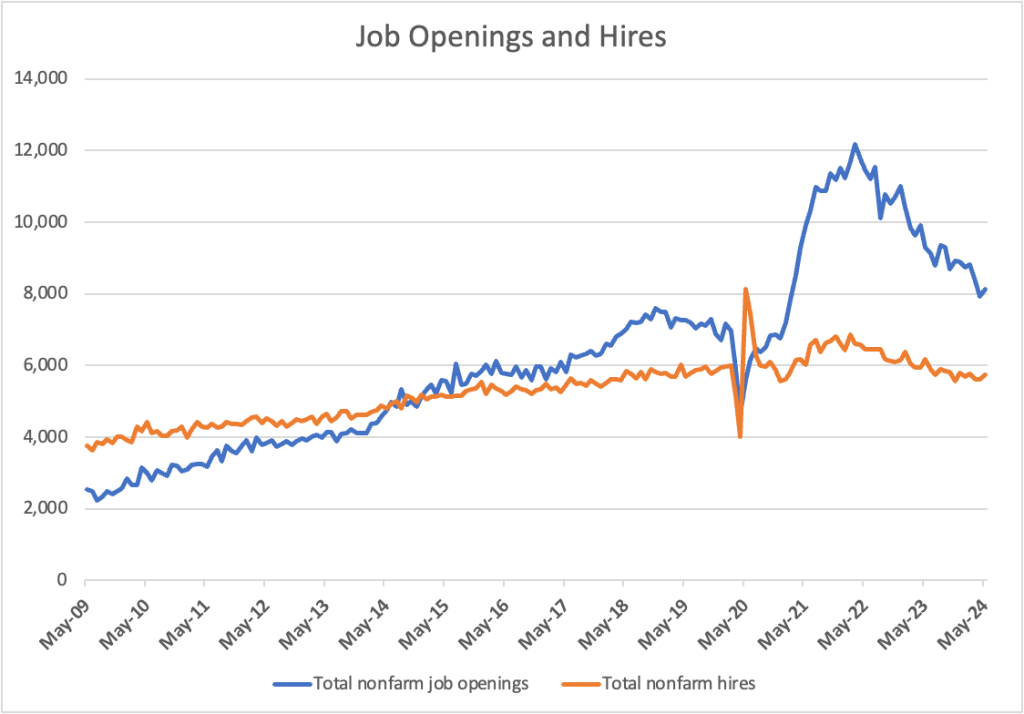
As a result, this increased headcount created higher levels of role ambiguity as more workers vied to create their own lanes of responsibility. At the end of my tenure at PlayStation, this created a mess of cross-departmental issues and political positioning which made it really hard to stay motivated – especially as someone who just wanted to GET THINGS DONE (instead of “building consensus” for months at a time).
Additionally, with more people vying for a limited number of promotions, employees are likely at best, stressed, and at worst, actively competing with each other for money and titles. There is typically a fixed amount of $ for promotions, raises, and bonuses, and this could create a culture of distrust and unnecessary backstabbing.

Climbing expectations of work input and output
Money was never *not important* to companies, but it feels like since COVID, there has been an especially maniacal, escalating focus on profitability. I’m not sure why/how this escalation occurred, but it certainly zapped the fun out of work (for me, at least). When I first started at PlayStation, the events we would host and/or participate in such as Destination PlayStation, E3, and PlayStation Experience were absolutely mind-blowing and consistently created employee rejuvenation during certain points of the year. The Christmas parties were held at breathtaking venues such as the Palace of Fine Arts in San Francisco and were an incredibly fun way to connect with colleagues before we all trotted away for Holiday Break (which was a 1.5 week recess which comprised of Christmas and New Years).

In addition to cutting down dramatically on in-person events, entertainment companies now seem wholly profit focused instead of creating art which in turn, can be monetized. Which recently, more often than not (in the video game industry), has resulted in some very, very bad games.
Rick Rubin, a legendary music executive who has produced a wife variety of records for banger artists (Beastie Boys, Linkin Park, Lady Gaga, Rage Against the Machine, etc.), has an awesome book which covers the meaning of creativity. In “The Creative Act: A Way of Being,” he writes – “We aren’t creating to produce or sell material products. The act of creation is an attemp to enter a mysterious realm. A longing to transcend. What we create allows us to share glimpses of an inner landscape, one that is beyond our understanding. Art is our portal to the unseen world.”
I truly believe that when I was inspired to start a career in video games (2013), publishers supported games that emphasized the artistic vision of its developers. Recently, however, it seems like this is no longer important or relevant.
Bad leadership is what is driving these once creative companies to fail… and bad games are not the only result of this awful leadership.
Poor leadership decisions which have resulted in, among other things, layoffs
While I was in the midst of writing this article, Bungie announced that they are laying off 17% of their workforce, or 220 roles. In addition to these 220 roles, 155 folks will transition over to Sony, and ~40 will transition to a new studio (Jason changed his number from 75 to ~40 in a subsequent post). In total, these numbers account for almost 1/3 of the company! It’s very easy to see a world where Sony cuts most of these people as well (in fact, I’d bet on it if I were a betting man) due to continued lagging sales of Bungie’s current products along with development costs of future titles.
This news resulted in a huge backlash from everyone in the industry, especially as X-verse (formerly known as Twitter) learned that the CEO of Bungie had been on a collector car buying spree for months leading up to the layoffs. IMO, it’s less about the money he spent ($2.4M), but more about the horrible message this sends to employees. If I were an executive, I’d want everyone at my company to know they had my full support and that I’d do everything in my power to be a good steward of their careers (such as Iwata-san did during the days of Wii U). “To avoid layoffs, Iwata took a 50% pay cut to help pay for employee salaries, saying a fully-staffed Nintendo would have a better chance of rebounding.” In hindsight, this was a fantastic decision as the Switch is doing extremely well, and I believe Switch 2 will only help Nintendo continue to succeed.
How companies can address these causes of burnout
Companies will have to take a long-term, sustainable approach to address these issues.
Reversing the disengagement trend will be difficult, but I believe the most successful companies will enforce some sort of flexible return to office (RTO) policy. It was a fun ride, but as remote worker engagement continues to decline, creating a flexible but clear in-office policy (likely hybrid) could be a great move to counter declining engagement levels. Regardless of what the “right” answer is, employees will self-select into whichever model works for them by choosing companies that align with their philosophy.
Hybrid work could also reset work boundaries which in turn, will hopefully bring back reasonable expectations from employees. Instead of viewing workers as remote working robots, interacting with folks around the office may allow the opportunity for reasonable expectations to return. Wall Street may not immediately like it, but I believe reasonable work output from employees will be more sustainable over the long-run (by decreasing burnout).
To address role ambiguity, companies must unfortunately continue to trim headcount which will reduce redundancy, and in turn, role ambiguity. As quoted from the “Update on Meta’s Year of Efficiency” article, “…part of our work will involve removing jobs — and that will be in service of both building a leaner, more technical company and improving our business performance to enable our long term vision.” Although the layoffs are necessary, I blame the leaders who hired way too many people in the good times and are now forced to cut. IMO, these “leaders” should be the ones losing their jobs instead of the worker bees, but 🤷🏽♂️.
Finally, leaders of these companies need to be properly held accountable. Rather than making bad decisions and then forcing the productive employees to take the heat, leadership should be properly vetted by multiple layers before they are brought in. It always shocked me that hiring lower level employees always had to clear multiple rounds of interviews, while the higher level folks (many of whom were awful) were able to skate on in. HR and board members should create a more holistic approach to hiring at the executive level instead of these decisions being made unilaterally.
 Vampire Financial
Leave a comment